

Mortality and the Maricón
a surreal sojourn in mexico

As the sun began its descent from high noon, a crowd gathered at the top of the hill. A distant drumming trickled down the empty cobblestone streets, and the tell-tale dust of a passed procession lingered in the air. The Mexican heat was unforgiving, and little patches of shade became proof of some ancient god that, maybe, wanted you to live through another day. As I picked my way through the crowd, a little weak from the ascent, the sound of drums waned and was replaced by labored breathing echoing across the cliffside. Two white horses stood at attention. Some forty people in robes gathered, hushed, before the crowd of us in our shorts and sun hats. At the center of the scene, a handsome young man gazed directly into the sun. His sides were blood-streaked from the whipping he’d just endured in the street. And now he was going to die. He spread his arms across the wooden planks suspending him in the air, closed his eyes under his crown of thorns, and pleaded to his Father to forgive his executioners, for they knew not what sin they were about to commit.
The passion play in Ajijic was my first. And there’s nothing more satisfying than popping your cherry in the perfect circumstances. Though I spent the afternoon far more concerned about a sunburn than my eternal soul, taking in the spectacle felt important. When I squeezed my way into this trip, the fact that it would be taking place over Good Friday was an afterthought. The main intention was to accompany my best friend who was to visit their father in the sleepy vacation town where he’d retired. But Friday morning, my best friend, we’ll call them Felix (they got to choose their own pseudonym for this piece), Mr. Dune, and I all woke up thirsty for Jesus.
After a dip in the pool of Felix’s dad’s apartment complex, we power-walked towards the center of town. The sun-drenched village is about an hour’s drive from Guadalajara and lies on the banks of Lake Chapala. While the town is tiny, the lake is massive, sprawling out at about 680 square miles. A two-lane highway runs along the edge of the lake and is permanently gridlocked with people getting from A to B. The center meridian of the highway, where there is one, boasts vendors selling the standard cups of delicious cut fruits, but also local ephemera like carved wooden spoons, giant macrame hangings and hammocks suspended from the trees. Our part of the highway felt more desolate — I kept thinking of it as a less ritzy Malibu (if you’ve spent any time in Malibu you’ll know there’s no there there. Just a collection of mini-malls along a highway). So we plodded through one gravel parking lot after another on our way to watch the cultural spectacle.
After walking for ten minutes, we encountered a young woman in uniform and white gloves directing traffic, and I stopped to ask her if we’d missed Christ’s procession down the street. She indicated that they’d gone up the hill, so we started up the cobblestone street bedecked with white and purple papel picado fluttering in any errant wisp of breeze. A few stragglers sat on the edge of the road, and we couldn’t tell whether we were meant to wait with them or continue seeking. An elderly couple looked at us, obviously resigned to the sight of more gringos in their town (Ajijic is home to a significant expat population), but gave us weary smiles nonetheless.
“Disculpa,” I began, “¿Dónde está Jesús?”
We all had a little chuckle at the idea of asking where Jesus was, and then the man told me to go up the hill, turn left, walk a block, then turn right.
“¿Debemos correr?” I asked if we should run and he laughed and shooed us up the incline.
Once we rounded the first corner, we came upon a group of young men with a long pole they used to reach into the tree above us to shake something loose. We’d seen locals doing this everywhere we went but weren’t sure what they were after. A seed pod fell into a young man’s hands, and when he caught me glancing at it, offered it to me.
“¿Para comer?” I asked him if I could eat it and he gave me a toothy grin like ‘of course.’ I held the curved green seed pod in my hand all the way up the hill until we found Jesus.
I lingered in the crowd long enough to get a good look at the fake blood, the real horses, the woman playing Mary sobbing at his feet. Then it quickly got too hot and I retired to a strip of shade alongside a collection of surly dads with their arms crossed and popped open my seed pod. My first instinct was to try to Google Lens it and find out what it was and how to eat it (I later found out it’s called guamúchil), but I resisted. I let my curiosity guide me as I gently cracked the outer shell. The pods each revealed a cluster of pink surrounding a hard black seed. I popped the fruit into my mouth and it revealed a slightly crunchy sweetness. The voice of the devil took the microphone in the passion play, tempting Christ one last time, and I happily enjoyed my mystery snack. Not a forbidden apple, but still very good.


Felix and Mr. Dune were ready to go shortly thereafter and I popped my remaining bits of fruit into their mouths. Crunching like kids, we picked our way down the piedras to a shop selling nieves (an iced fruit treat kind of between sorbet and a granita) and ice cream. Finally relaxing into the cool, we shared a mango nieve and coconut ice cream. But our rest wasn’t to last long — Jesús was on the move again. Traffic stopped and we saw a primitive stretcher containing a gauze-wrapped body held aloft by a group of peasants in robes, followed by deadly-serious Roman centurions. Mr. Dune said He saw one break character momentarily as a little girl on the sidelines called out ‘papá!’ and he gave her a tiny wave behind his shield. The procession terminated at the Church, where Christ’s body was taken backstage, and the actors’ families gathered on the lawn, waiting for them to emerge.
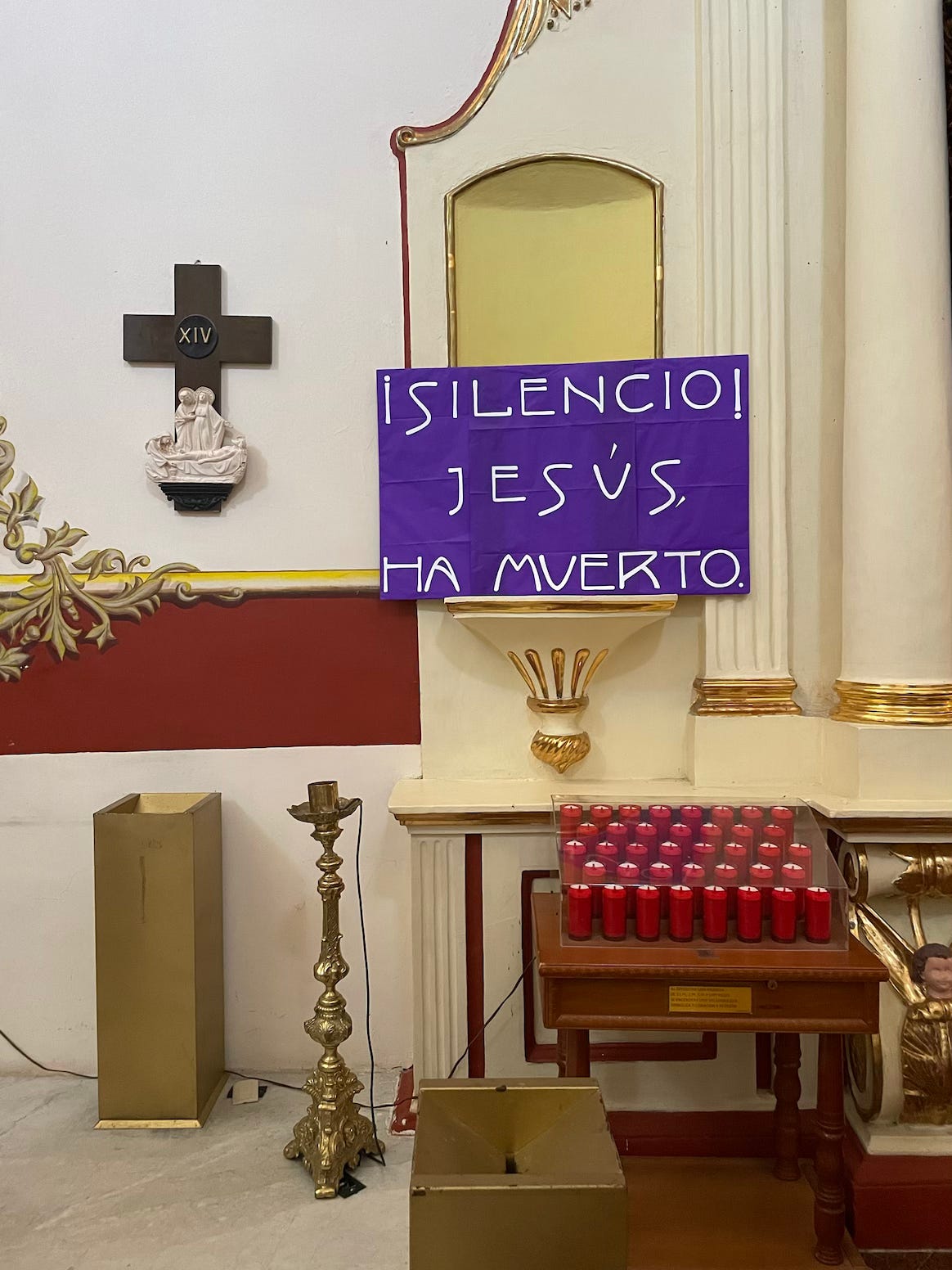
One of the first out was a man in slightly more adorned robes — long black ones with silver embroidery. As he descended the church steps, a little girl looked up at him in wonder and asked who he was. He replied in a sonorous tone:
“Mi nombre es Pedro. ¿Y tu?”
She gasped, stunned into silence at this chance meeting with Saint Peter. He smiled and patted her on the head. Moments later, he sneezed a gargantuan sneeze and one of his fellow actors shouted across the crowd:
“¿Qué salgo?” (What’s coming out?)
Pedro regarded his hand for a moment, milking the comedic effect, then proclaimed, “no sé,” (I don’t know.)
Soon an easy affect overtook the assembled cast as they gathered for a group photo. It had every ounce of camaraderie of your average theater cast party. Everyone jostled in their costumes, complained about how dusty and hot it had been. I even spoke with a guy about the big job:
“Have you ever played Jesus?” I asked.
“No,” he said, shaking his head. “Not yet.”
“Maybe next year?”
“No way. It’s so hot. We had to give him water all day. It’s too hard to be Jesus.”
Amen.
It was then that Felix began to grow antsy about checking in with their dad. This trip was the first time they'd seen him in years, and each minute felt important, especially since he'd recently turned 78. He’d been a second father to me growing up, a cool creative guy with a passion for writing, drinking beer, and reading huge novels on public transportation. He was part of a cool group of long-distance runners that were constantly partying together. We’re not going to make too many assumptions, but there was a photo on the wall in my bestie’s house growing up of their dad in a hot tub, arms around his wife and another woman runner, kissing the other woman runner on the lips. This final act in Ajijic seemed to me, not having seen him in about ten years, to be the ultimate culmination of his cool literary fuckboy lifestyle. Aspirational. Idyllic.
But the man I found at the end of the pilgrimage wasn’t who I expected. Time had lapped against him like water, wearing down the cool exterior and leaving a tangle of anxieties about mortality and what he’d done with his life. He’d had a very cool creative job while we were growing up, but he revealed at dinner our first night that his boss had been a toxic psycho that made the whole thing miserable. He obliquely lamented never writing the novel he had in him, and made constant self-conscious references to this town filled with aging expats and his place among them. Sitting in the living room of the pre-furnished two bedroom apartment he’d lived in the last eight years, we noted how nice and quiet it was. “It’s a tomb,” he said derisively.